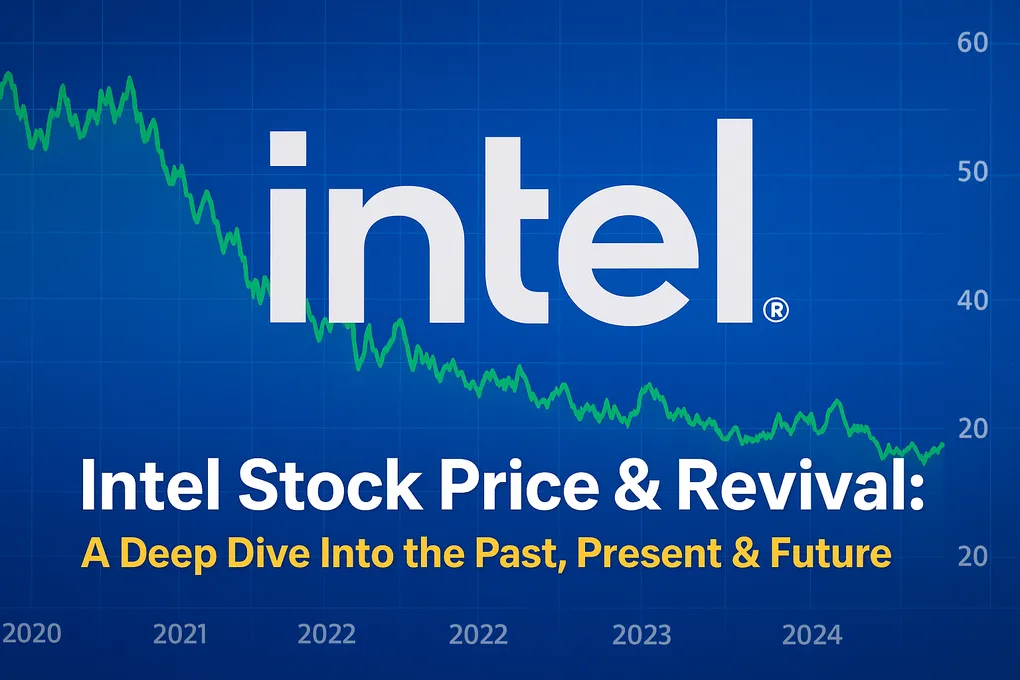
Intel Stock Price & Revival: A Deep Dive Into the Past, Present & Future
Intel Stock Price & Revival: The Complete Investor Playbook
Intel (NASDAQ: INTC) sits at the center of three massive storylines: the renaissance of U.S. chip manufacturing, the global race for AI compute, and the transformation from an integrated device manufacturer into a modern systems + foundry company. Below, you’ll find a deep, practical analysis for long-term investors in the U.S. who care about value creation, execution risk, and policy winds.
Live INTC chart via TradingView. Data and tools © TradingView.
(for busy investors)
- Price action (5y): Significant cyclicality with deep drawdowns and rebounds. See live chart above and auto-computed stats below.
- Core thesis: A multi-year turnaround hinging on process leadership (18A/14A), foundry wins, and competitive AI products (datacenter CPUs + accelerators).
- Key risks: Execution slippage on nodes, foundry utilization, margin pressure from capex, competition (TSMC, NVIDIA, AMD), and geopolitics.
- What Americans want from INTC: Durable U.S. manufacturing capacity, high-quality jobs, supply chain resilience, credible returns (margin recovery, disciplined capex), and transparent governance.
The Last 5 Years: What Actually Happened
1) Price & Valuation Context
- Multiple compression/expansion: INTC’s valuation swung with confidence in the roadmap. Expect volatility around node milestones (Intel 4 → Intel 3 → 20A → 18A → 14A).
- Drawdowns: Market re-rated Intel during roadmap delays and datacenter share pressure. Peak-to-trough drawdowns reflect the market’s skepticism on execution.
- Recoveries: Rallies often coincided with positive node updates, U.S. policy support for domestic fabs, and signs of traction in AI and foundry.
2) Fundamentals You Should Track (simple checklist)
- Gross margin trajectory (node transitions initially dilute, then recover with yield/mix).
- Datacenter & AI mix (Xeon, Granite Rapids/Sierra Forest families; accelerators for training/inference).
- Client PC units ASP/mix (ulthin notebooks, AI PC uplift).
- Operating cash flow vs. capex (sustainable funding of fabs without starving R&D).
- Foundry external revenue and long-term agreements (LTAs) to prove the model.
U.S. Footprint — States That Matter (and Why)
Intel’s U.S. manufacturing and R&D network is central to policy, jobs, and national resilience:
- Arizona (AZ) — High-volume fabs in Chandler; advanced nodes; packaging.
- Oregon (OR) — Hillsboro is the R&D heartbeat (process development, pathfinding).
- New Mexico (NM) — Rio Rancho advanced packaging and manufacturing support.
- Ohio (OH) — New “Silicon Heartland” mega-site (greenfield fabs shaping the next decade).
- California (CA) — Santa Clara HQ; architecture, software, and platform engineering.
Why U.S. investors care: these sites anchor skilled jobs, ecosystem clusters (suppliers, tooling, talent), and policy incentives (federal + state), all feeding back into domestic capacity and supply-chain security.
Technology & Roadmap — The Non-Negotiables
-
Process nodes:
- Intel 3 (matured for datacenter/client).
- 20A / 18A (RibbonFET + PowerVia) — the inflection meant to regain performance-per-watt leadership.
- 14A (High-NA EUV era) — foundational to the post-18A roadmap; crucial for performance density and competitiveness into the late 2020s.
-
Products that must land:
- Datacenter CPUs: Xeon roadmaps (efficiency/perf-core splits) for cloud and enterprise.
- AI accelerators: Competitive training/inference parts to complement CPUs and protect server share.
- Client “AI PCs”: On-device NPU performance, battery life, and developer ecosystem (Win + Linux toolchains).
-
Packaging & systems:
- EMIB, Foveros, Co-EMIB — heterogeneous integration to mix process nodes and 3rd-party dies; unlocks system-level PPA wins.
- Software enablement: Deep stacks (compilers, libraries, frameworks) to improve utilization of silicon, especially for AI workloads.
Intel Foundry — From Vision to Utilization
- The business model shift: Opening fabs to external customers is strategically necessary. Success = credible PDKs, predictable schedules, competitive yields, and cost parity vs. TSMC/Samsung at target nodes.
- Utilization & LTAs: Investors want to see booked wafers (external + internal), disciplined pricing, and a pipeline that ramps through 18A → 14A.
- Advanced packaging services: Faster revenue on-ramps vs. full-node wafer wins; a practical bridge to prove service quality.
Capital Allocation & Balance Sheet Discipline
- Capex cycles: Node and site ramps are capex heavy; investors need clear ROI paths (utilization, yields, blended ASPs).
- Margins: Expect near-term pressure during ramps; medium-term target is to restore gross margin with scale and product mix.
- Buybacks/dividends: Prioritize balance sheet flexibility until foundry and AI ramps validate cash generation. Americans largely prefer durable dividends over peak-cycle buybacks.
- Partnerships/co-funding: Smart use of tool vendor financing, customer pre-pays, government incentives to reduce net cash burden.
Trending Intel Headlines (What to watch)
- Policy & incentives: CHIPS-related grants/credits, state-level packages, and any new public-private partnerships tied to U.S. fabs.
- Node milestones: Tape-outs, risk production, and early volume on 18A, plus timeline clarity on 14A (High-NA EUV).
- AI attach rates: Adoption of AI-capable client PCs; datacenter wins where CPUs + accelerators ship together.
- Foundry customer adds: Any third-party anchor customers, LTAs, or packaging-only ramps.
- Leadership & org: Stability in execution leadership, and operating expense control without starving long-lead R&D.
What U.S. Investors Want From INTC (Right Now)
| Priority | What “Good” Looks Like | Why It Matters |
|---|---|---|
| Execution on 18A/14A | On-time, on-yield nodes; credible perf/watt leadership | Re-rates the multiple; restores trust |
| Foundry Traction | External revenue growth, capacity visibility, LTAs | Proves the new model; improves fab economics |
| AI Competitiveness | Server share defense + accretive accelerator sales | Lifts margins; strategic relevance vs. peers |
| Margin Recovery | GM expansion as ramps mature; disciplined opex | Funds innovation; supports sustainable dividends |
| Capex ROI | Measurable returns on fabs/tooling | Avoids value-destructive spending |
| U.S. Capacity & Jobs | Tangible progress in AZ/OR/NM/OH; training pipelines | Aligns with policy + social license to build |
| Transparent Governance | Clear comms on strategy, risk, capital, and milestones | Reduces uncertainty premium |
Scenarios (Investor Frame)
- Bull case: 18A hits on time with strong yields; packaging revenue scales; at least one marquee foundry customer; AI PC uplift + datacenter mix expand GM; multiple re-rates.
- Base case: Mixed execution; packaging grows; foundry ramps slower; AI attach helps margins; returns improve but remain below best-in-class.
- Bear case: Node slips; under-utilized fabs; AI products underwhelm; capex burden lingers; further multiple compression.
Actionable Watchlist (DIY due diligence)
- Quarterly: gross margin, capex, OCF, foundry revenue, backlog/LTAs, AI product updates.
- Annually: utilization levels, node cadence vs. plan, balance sheet leverage, state/federal incentive progress.
- Newsflow: site build milestones (OH), packaging expansions, ecosystem partnerships, tool vendor lead-times.
Final Take
Intel can absolutely work as a multi-year thesis for U.S. investors who value domestic capacity, deep engineering IP, and the optionality of a true systems-plus-foundry model. The market will keep punishing misses and rewarding evidence of execution. If Intel:
- lands 18A and prepares 14A,
- proves foundry utilization with real customers, and
- ships competitive AI platforms,
then INTC has room to expand both earnings power and the multiple investors are willing to pay.
This article is for education, not investment advice. Always do your own research and consider consulting a licensed advisor.