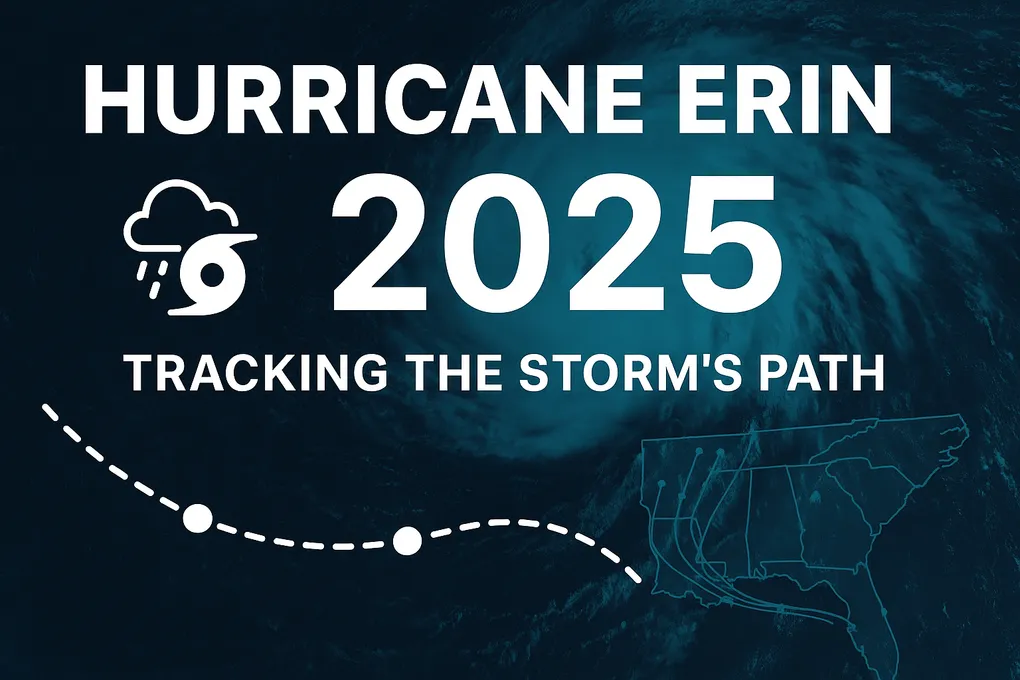
Hurricane Erin 2025 Tracking the Path, Models, and Impact
🌪 Latest Updates on Hurricane Erin
- Erin Becomes the First Major Hurricane of 2025
- On August 15, Erin officially became the first hurricane of the 2025 Atlantic season, rapidly strengthening from a tropical storm to Category 1 status with sustained winds of approximately 75 mph (axios.com).
- Forecasts anticipate rapid intensification, with Erin potentially reaching Category 3 or even Category 4, catapulting it into the “major hurricane” classification over the weekend (axios.com, theguardian.com, weather.com, nypost.com).
Approaching the Caribbean
- Erin is currently moving west-northwest just north of the Caribbean islands, particularly near Puerto Rico and the Virgin Islands, prompting tropical storm watches in areas like Anguilla, Antigua, and St. Martin (theguardian.com).
- Areas in its projected path may experience heavy rainfall up to 6 inches, raising concerns over landslides and flooding (theguardian.com).
Risks Along the U.S. Eastern Seaboard
- While Erin is forecast to turn northeast and remain offshore, coastal areas—from Florida to New England—should prepare for dangerous surf, beach erosion, and rip currents (theguardian.com).
- Particularly, Atlantic beaches from North Carolina to Massachusetts may face huge waves and churning seas in the coming days (abcnews.go.com, yaleclimateconnections.org, wcvb.com).
Broader Weather Context and Impacts
- The 2025 hurricane season remains highly active—NOAA now forecasts 13 to 18 named storms, with several expected to become major hurricanes (axios.com).
- Erin is becoming a real-world test of the U.S. hurricane preparedness system. Budget cuts to NOAA and the National Weather Service may constrain response efforts, even as forecasting tools such as NOAA’s upgraded hurricane model improve storm intensity predictions (vox.com).
Hurricane Erin 2025: Tracking the Path, Models, and Impact
Hurricane Erin is currently being monitored by the National Hurricane Center (NHC) as it develops in the Atlantic. With the potential to impact parts of the United States and Caribbean, understanding its path, projected impact, and spaghetti models is critical.
Current Status
As of the latest update, Hurricane Erin is classified as a Category 1 hurricane with sustained winds of 85 mph. It is moving northwest at 12 mph, and forecasters expect the storm to strengthen over the next 48 hours.
Projected Path
Meteorologists are closely monitoring the projected path of Hurricane Erin. Spaghetti models indicate a range of possible tracks, with several predicting landfall along the southeastern U.S. coast, while others show a potential curve away into the open Atlantic.
Spaghetti Models and Forecast Data
Spaghetti models compile multiple forecast simulations from different weather prediction centers. For Hurricane Erin, these models are showing a high degree of uncertainty, making it essential to stay updated with the latest advisories from the NHC.
Preparedness and Safety
If you are in a potential impact zone, review your hurricane preparedness plan, stock up on emergency supplies, and follow evacuation orders if issued. Early preparation is the key to safety.
Resources
- National Hurricane Center
- NOAA Hurricane Center
- The Weather Channel
- Erin becomes 2025’s first major hurricane as storm intensifies
- Tropical storm turns into Hurricane Erin as it approaches Puerto Rico and Virgin Islands
- Heavy rains expected in Puerto Rico and Virgin Islands as Hurricane Erin nears
Stay tuned for more updates as Hurricane Erin’s path becomes clearer.